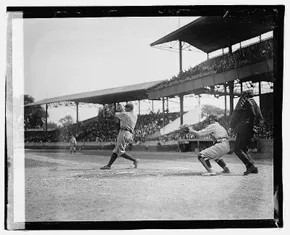
George Ruth Jr. showed promise as a shirtmaker. He didn’t show much promise as a person, at least not in the way St. Mary’s Industrial School for Boys wanted. But on the field? He was different.
Baseball wasn’t just a hobby there. It was the religion. The Xaverian Brothers ran the place with iron rules, but they also believed play was the eighth sacrament. Dorms competed against trade groups. Tournaments ran until the weather broke. For a kid who was already huge for his age, the diamond was the only place that made sense.
He was eight or nine, playing with twelve-year-olds. By twelve, he was hanging with the sixteen-year-olds. At sixteen, he was on the varsity squad, pitching against grown men up to twenty years old.
Brother Matthias and the Pigeon-Toed Catcher
Ruth didn’t get good by accident. He got good because Brother Matthias made him.
Matthias was an imposing figure. He’d wear a glove on his left hand, toss the ball out of it, and then slug a fly with the bat in his right. Some say he once injured a boy swinging with both hands. He was a great hitter. Ruth remembered that.
But Matthias also taught Ruth how to run. Specifically, he taught him to run pigeon-toed.
The theory? If you push off with all five toes, you’re faster. It seemed to work for the gangly kid. That pigeon-toe trot became part of the legend.
Ruth could play any position. He was left-handed, which meant he had to wear a right-handed glove. His choice was catcher. He had a cannon for an arm.
One teammate claimed Ruth had a fancy trick for stealing base runners. Catch the ball in the left glove, toss it straight up, drop the mitt, catch it barehanded, then throw.
“He would catch the ball in the glove on his left hand, toss the ball straight up, drop the mitt on the ground, catch the ball again in his bare left hand and throw.”
Unlikely, right? Maybe. It’s more probable he did what every left-handed catcher did back then. He wore the glove on the wrong hand. Photos from St. Mary’s confirm it. He just wore the left-handed mitt on his right hand. Simple. Effective.
Why Did Babe Ruth Start Pitching?
Hitting came naturally to Ruth. Fielding took discipline. Matthias provided that.
Ruth was the star catcher for the Red Sox, one of the intramural teams at St. Mary’s. All the teams were named after major league clubs. But he became a pitcher. How?
There are two stories.
In one, the starting pitcher, a guy named Congo Kirby, got his baseball privileges revoked for a misdemeanor. Ruth asked Matthias if he could take over.
In the other, Kirby was getting beat up in a game. Ruth found it hilarious. He was cracking jokes from the bench. Matthias, using the eternal wisdom of teachers everywhere, said, “If you know so much about pitching, why not do it yourself?”
So he did. A superstar hurler was born.
By 1912, the 17-year-old Ruth was turning heads. The St. Mary’s newspaper reported a game where he batted leadoff. He hit a homer, a triple, and a double. In the same game, he played third base, caught, and pitched six strikeouts.
The following summer, the walls of St. Mary’s felt small.
As a pitcher, he was undefeated. As a catcher, he batted .537. In one intramural game, he struck out 22 batters. Newspaper sources suggest the 18-year-old was playing for semipro teams in the area.
A local article mentioned a pitcher for the St. Patrick’s Catholic Club named “Roth.” They called him “the speed boy.” His fastball was noteworthy. At 6’2″ and 150 pounds, he had the frame to deliver the smoke. He also showed up in the boxscore for another semipro team, the Bayonnes, that year.
In February 1918, Baseball Magazine interviewed the then-24-year-old Ruth. He looked back at his school days.
“I wasn’t a pitcher in those days until I was pretty nearly through my course. My main job was catching… I used to hit .450 and .500. I kept track one season and found that I made over 60 home runs. The last two years I pitched and got along pretty well, but I never lost my taste for hitting and don’t expect to.”
At the time of that interview, Ruth had only hit nine major league home runs. He was strictly a pitcher.
Yet he mentioned the magical 60-homer number. No one in history had hit half that many. Ruth wouldn’t reach it for nearly ten more years. It seems strangely prophetic.
The Game Against St. Joseph’s
The Xaverian Brothers ran another school nearby. Mount St. Joseph’s. It was a boys’ college.
The rivalry was good-natured. The Industrial School boys thought the college kids were snobs. The college kids thought the Industrial School boys were ruffians.
Mount St. Joseph’s had their own star pitcher. Bill Morrisette. In 1913, Morrisette used his spitball to throw a no-hitter, a one-hitter, a three-hitter, and a five-hitter. He faced competition like Holy Cross, Georgetown, and Bucknell. Morrisette would eventually have a 13-game major league career.
The Brothers had a plan.
For the commencement day festivities at Mount St. Joseph’s, they cooked up a matchup. Ruth would pitch against Morrisette.
The Runaway and the Revenge Game
Pressure? It got to him. For the first time anyone could tell, the guy who would eventually become the Babe was terrified. Ten days before the big match, he bolted. Left St. Mary’s behind. It was the first time he’d walked out in two years.
The other boys were shocked. Rumors flew. He vanished for two days before the school’s probation officer and a night watchman tracked him down. Found him hanging around his old spots on the piers.
The official story said he came back on his own. The other boys didn’t buy it.
They didn’t trust that excuse. So the punishment came. Heavy. No ball for five days. Instead, he stood guard. Watched the road between the Big Yard and the Little Yard. Just watched them play. He paid his penance. Then Brother Matthias stepped in. Reminded him the game was in two days. Told him to start throwing again. Now.
What happened next is clear. The details of the challenge match are lost, but the result isn’t. Ruth dominated. He struck out at least 14 guys from Mount St. Joseph’s. Allowed zero runs. His own side, Morrisette, got raked. Six runs allowed. Maybe more.
By then, even the pros couldn’t look away. Young George’s stats were too loud to ignore. How did George Ruth Jr. make it to the majors? That’s the next chapter.
More on the game:
- Baseball history
- Minor League Baseball teams
- Baseball Hall of Fame inductees