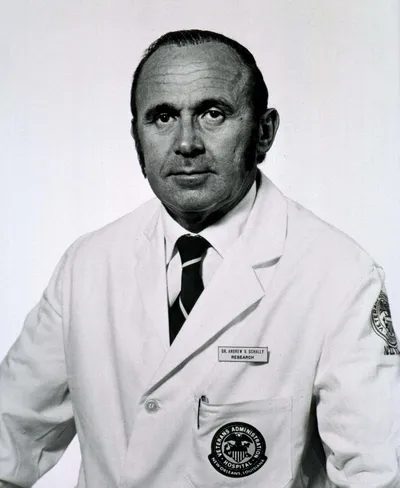
Andrew V. Schally died on October 17, 2024, in Miami Beach, Florida. He was 97. A Polish-born American endocrinologist, his work fundamentally shifted how we understand the brain’s control over the body’s chemical messengers. He shared the 1977 Nobel Prize in Physiology or Medicine with Roger Guillemin and Rosalyn Yalow. The prize recognized a singular achievement: isolating and synthesizing three specific hormones produced by the hypothalamus. These hormones act as master switches, directing other glands to release their own substances.
A Wartime Escape and Academic Journey
Schally’s path began in Wilno, Poland, born November 30, 1926. The region is now Vilnius, Lithuania. He fled with his family in 1939 as war loomed. This displacement set the stage for a peripatetic academic career. He studied at the University of London. For three years, he worked at the National Institute for Medical Research there. Then he moved to Canada. He entered McGill University in Montreal.
He graduated in 1955. Two years later, he earned a Ph.D. in biochemistry. From 1957 to 1962, he was associated with Baylor University in Houston, Texas. In 1962, Schally became a U.S. citizen. That same year, he took a pivotal role. He became chief of endocrine and polypeptide laboratories at the Veterans Administration Medical Center in New Orleans. He also joined the medical faculty at Tulane University School of Medicine. He became a professor there in 1967. By 1973, he was named senior medical investigator with the VA.
The Synthesis of Brain Hormones
So, why is Schally’s work considered so important? The hypothalamus is a small region of the brain. It produces hormones that regulate other glands. Before Schally and his contemporaries, scientists knew these hormones existed. They could not isolate them. They could not synthesize them. This made study nearly impossible.
Schally’s chief accomplishments included the synthesis of TRH. This is thyrotropin-releasing hormone. He also isolated and synthesized LHRH. This is luteinizing hormone-releasing hormone. Additionally, he studied the action of somatostatin. This is a peptide that inhibits other hormones.
His research helped elucidate pathways of hormone regulation in males and females.
This work was not just theoretical. It had concrete applications. The isolation of these hormones contributed directly to the development of fertility treatments. It also aided in the creation of contraceptives. The ability to synthesize these substances allowed researchers to manipulate hormonal pathways with precision.
Recognition and Legacy
The scientific community recognized these achievements early. In 1975, Schally and Guillemin received the Albert Lasker Basic Medical Research Award. The Nobel Prize followed two years later. Their shared discovery provided a clear map of how the brain signals the body. It ended decades of guesswork in endocrinology.
Schally’s methods opened doors for countless other studies. They showed that the brain and glands are in constant, complex dialogue. Understanding this dialogue changed medicine.