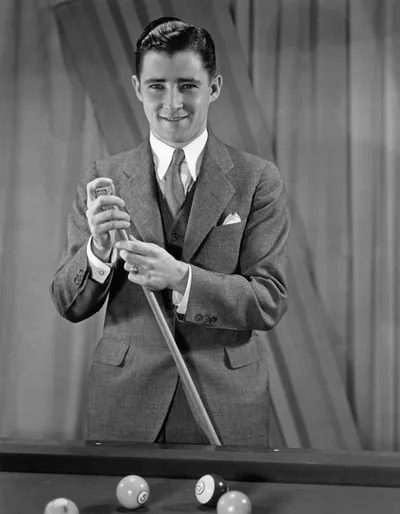
Willie Mosconi wasn’t just a player. He was the architecture of pocket billiards’ reputation. Before him, the game was often associated with smoke-filled backrooms and shady characters. After him? It was respectable. It was a gentleman’s sport.
Born in Philadelphia on June 27, 1913, Mosconi grew up inside the game. His father owned a billiards parlor. The kid had talent. Raw, undeniable talent. But his father wanted better. He wanted Willie in vaudeville. So the boy practiced with potatoes and a broomstick. You can’t hit a pocket with a potato. But you can learn the geometry of the table. You can learn the physics of the stroke.
When the Great Depression hit, vaudeville was a dream he couldn’t afford. He started playing professionally in 1931 or 1932 to feed his family. The rest is history.
Dominance on the Table
Mosconi didn’t just play. He dominated. He won the men’s world championship 15 times between 1941 and 1957. That’s not a streak. That’s an era.
His titles came in waves:
* 1941
* 1942
* 1944–45
* 1947–48
* 1950–57
He played with a speed that looked like magic. Rapid-fire shooting. Accurate. Deadly. During one exhibition, he racked up 526 consecutive successful shots. That isn’t luck. That is muscle memory dialed in so tight it borders on supernatural.
“Mosconi’s demeanor helped establish pocket billiards as a reputable pastime.”
He even dipped into Hollywood. He advised on The Hustler (1961). He executed the fancy shots you see on screen. He taught the actors how to hold the cue. How to look like they knew what they were doing. Which, of course, he did.
The Stroke That Stopped the Clock
Then, in 1957, the stroke that ended his career happened. Not on the table. In his body. A cerebral stroke. He was forced to resign.
But Mosconi didn’t fade away. He got stronger. He got skilled again. He returned to the table. He won regularly. It’s rare for a player to come back from that level of neurological disruption and still be at the top.
He stayed involved. He consulted for the Brunswick Corporation. He appeared on television demonstration games. He wrote two books: Winning Pocket Billiards (1965) and his autobiography, Willie’s Game (1993).
He died on September 16, 1993, in Haddon Heights, New Jersey.
The game moved on. New stars emerged. Faster cues. Better balls. But the standard? It was still Willie. The gentleman. The 526-break legend. The guy who made pool look good.
You still see his name in the footnotes of every serious player’s journey. Not just as a record holder. As a benchmark. Can you hit like Mosconi? Can