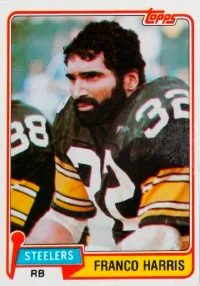
Franco Harris looked like a standard NFL battering ram. He sat at a well-tapered 225 pounds. He looked ready to lower his head and smash through the line. People expected the usual head-down, pile-driving style.
They were wrong.
Harris was a fullback who ran with the agility of a smaller scatback. He was big, yes. But he wasn’t just a brute force. His best runs came when he knife-edged off the tackle. Then he would cut back against the grain.
Speed and agility gave him a step on pursuing defenders. His size let him trample the ones he left behind. It was a unique combination.
His smartest plays, though, happened when he was trapped near the sideline. There was no hope of escaping into open field. Most players would fight for those extra inches. Harris stepped out of bounds instead.
Pittsburgh fans hated it. They wanted every yard.
Harris didn’t care about the crowd’s disdain. He knew staying healthy mattered more than meaningless gain. This intelligence allowed him to play 13 seasons in the NFL. He carried the ball 2,949 times. He still ranks third in all-time rushing yards with 12,120 when he retired after the 1984 season.
The Underdog who became a legend
Before Pittsburgh, Penn State viewed him as an underachiever. The Steelers picking him first overall in the 1972 draft was seen by many as a stretch.
He didn’t start until late in that rookie season. Yet he rushed for over 1,000 yards. He helped put the Steelers into the playoffs for the first time since 1947.
Then came the moment that defined his career.
In the final seconds of that playoff game, the “Immaculate Reception” happened. A deflected pass. A shoetop grab. Harris turned it into a touchdown. Pittsburgh won.
He went on to lead the team to four Super Bowl victories. In Super Bowl IX, he was the MVP. He rushed for 158 yards on 34 carries.
The soft-spoken, dignified Harris proved that football isn’t just about power. It’s about knowing when to run it and when to step out of bounds.
Franco knew, of course, that it was more important to the Pittsburgh cause that he stay healthy for the next play.
His style enabled him to play 13 seasons in the NFL even though he ran the ball 2,949 times. His 12,120 rushing yards ranked third all time in NFL history when he retired after the 1984 season.