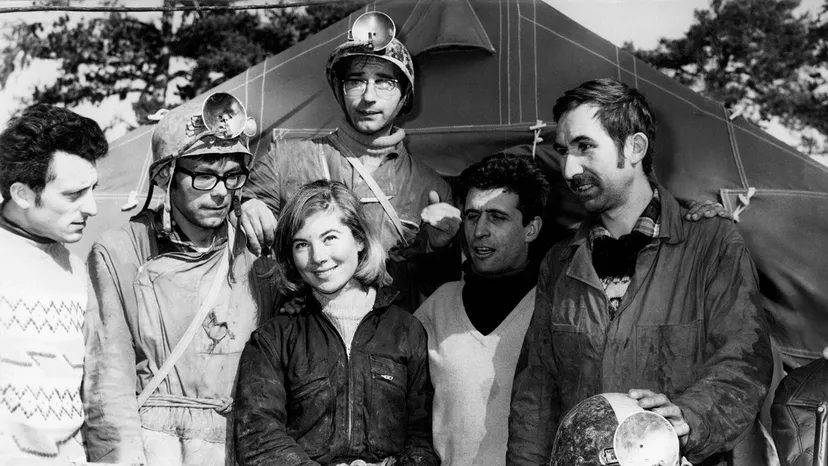
Josie Laures and Antoine Senni thought they had just spent a few weeks underground. When they finally stepped out into the French Alps, they were wrong. Lares emerged on March 12, 1965, convinced the date was still February 25. She had actually been in total darkness for 88 days. Senni surfaced on April 5, believing it was only February 5. He had spent 126 days without a single ray of sunlight.
Both had set world records for longest solo cave stays. But the real story wasn’t the endurance. It was the biology.
Without the sun to anchor them, their internal clocks shattered. Senni would slip into sleep for up to 30 hours, waking up feeling rested, as if he had merely dozed off for an hour. Laures’ rhythm was so fractured that she struggled to re-sync with normal sleep cycles even after exiting the cave.
This isn’t just a quirk of extreme adventurers. Similar studies over decades show that when people are cut off from light cues, their bodies invent new sleep-wake patterns. The result? A complete loss of time perception.
How does this happen? And what does it do to your mind when you can’t tell if it’s morning or midnight?
Jonathan S. Emens, M.D., a board-certified sleep medicine specialist and associate professor of psychiatry at Oregon Health & Science University, explains the mechanics. To understand the breakdown, we first need to look at what keeps our bodies ticking in the first place.
What Regulates Our Internal Clocks?
Your body runs on a 24-hour cycle. These are circadian rhythms. They dictate when you feel sleepy, when your body temperature drops, and when hormones spike.
The driver is an internal pacemaker in the brain. Specifically, a cluster of neurons called the suprachiasmatic nuclei (SCN) in the hypothalamus.
“You can think of it like your heart,” Emens says. “The pacemaker in your heart spontaneously generates the rhythm in electrical impulses that ultimately cause the heart to beat.”
Your brain has a similar device. The SCN generates a near-24-hour rhythm on its own. A heart beats once per second. The circadian pacemaker completes one full cycle roughly every 24 hours.
You can think of it like your heart — the pacemaker in your heart spontaneously generates the rhythm in electrical impulses that ultimately cause the heart to beat.
Without sunlight to reset this clock, the rhythm drifts. It doesn’t stop. It just gets out of sync with the world outside.
The Light Switch in Your Brain
We have a whole menu of environmental cues to help set our internal clocks. Exercise. Caffeine. Shift work schedules. They all act as zeitgebers, those time-giving signals that try to keep us synchronized. But none of them compete with the real boss.
Light.
Specifically, light hitting the eyes.
This isn’t just about seeing. It’s about survival timing. Special cells in the retina—intrinsically photosensitive retinal ganglion cells, or ipRGCs—do the heavy lifting. Alongside standard rods and cones, these cells send raw light data straight to the suprachiasmatic nucleus (SCN), the master clock in your brain. The connection is monosynaptic. Direct. Even eyelids don’t block it completely. Artificial light can trigger it too.
The result? Your pacemaker resets. Earlier. Later. Harder. Softer. It depends entirely on when the light hits, how bright it is, how long it lasts, and its wavelength.
Living Without the Sun
What happens when you remove the sun?
Research published in PNAS offers the clearest picture. Under strict isolation, the human biological day doesn’t last 24 hours. It stretches. On average, it’s 24 hours and nine minutes.
Women’s internal days are slightly shorter. Men’s are slightly longer. The rhythm isn’t locked to the clock on your wall. It drifts. We stay on track only because sunlight resets us daily.
Cut off the light. Isolate someone in total darkness for months. The clock goes haywire.
If your natural cycle is 24 hours and 9 minutes, it will drift later every day. If it’s shorter, it drifts earlier. Keep them in the dark long enough, and their sleep-wake cycle will drift completely around the clock.
The cost? High.
Laures spent 88 days in total darkness. The experience broke down her motivation. At first, she read. Then she lost interest. She listened to music. Knitted. Waited.
“It became very difficult toward the end,” she told the Associated Press. “I felt terribly worn out… I looked forward to the time when I would finally see the sun.”
Circadian disruption isn’t just about being tired. It’s linked to mood disorders.
Look at the Chilean miners. Trapped 69 days underground in 2010. The rescue team didn’t just send food and water. They sent special lighting. They needed to recreate day and night cycles. To keep their minds and bodies from unraveling.
When the clock breaks, everything else suffers. The body doesn’t know when to rest. The mind doesn’t know when to engage. You are left waiting for the sun, even if the sun is just a bulb in a helmet.

The Reset Button for Your Body Clock
After spending enough time in total darkness to completely scramble your sleep-wake cycle, the solution might be simpler than you think. A solid dose of sunlight is often all it takes to reset the circadian pacemaker, pulling your internal rhythm back into alignment with the standard 24-hour day.
How Blindness Disrupts Circadian Rhythms
If your eyes cannot transmit light signals to the suprachiasmatic nucleus (SCN), your circadian rhythm loses its primary trigger. This disconnection creates a significant problem for roughly 55 to 70 percent of individuals with total blindness, specifically those who have no light perception at all, according to researcher Emens.
Without that light input, the timing of the circadian pacemaker begins to drift. It moves progressively later or earlier each day, pulling all the physiological rhythms it controls along with it. This includes the fundamental regulation of when you sleep and when you stay awake.
Understanding Non-24 Sleep-Wake Disorder
This specific condition in totally blind individuals is known as non-24-hour sleep-wake rhythm disorder, or simply non-24. While many people with this diagnosis still attempt to maintain a traditional 24-hour schedule for work, socializing, and sleep, their internal biology tells a different story.
Because the pacemaker is constantly drifting in and out of sync with the external 24-hour cycle, symptoms fluctuate. When the internal clock is out of sync, patients experience nighttime insomnia and daytime sleepiness. When it finally aligns with the outside world, they enjoy symptom-free periods. It is a cycle of misalignment followed by brief harmony.
FDA Approval of Tasimelteon
In January 2014, the U.S. Food and Drug Administration (FDA) approved the first medication specifically designed to treat non-24 in totally blind individuals. Hetlioz, which contains the active ingredient tasimelteon, works similarly to melatonin. It acts on the SCN to help reset the master body clock. To date, it remains the only FDA-approved drug for this specific condition.
“As a result, the timing of the circadian pacemaker, along with all the many, many rhythms under its control, all drift to a progressively later or earlier time each day.”
Can Sighted People Get Non-24?
It is possible for sighted people to be diagnosed with non-24, though the context changes. Emens notes that this diagnosis in sighted individuals usually mirrors what happens when healthy people are placed in an environment devoid of any time cues for an extended period. This often occurs in experimental laboratory settings, where the lack of external light signals allows the internal clock to drift just as it does in total blindness.