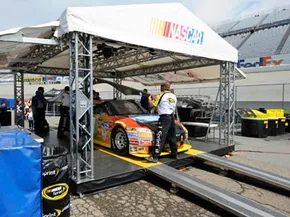
It is 10 a.m. on a Sunday morning at Atlanta Motor Speedway. The garage area is already buzzing. On the south side of that long steel building, inspectors are rolling cars through a line for one final look. These sleek machines are about to turn this peaceful morning into five hours of continuous thunder.
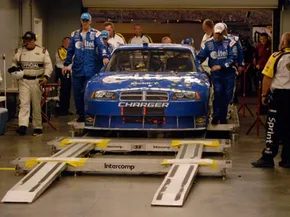
The teams push their cars onto an elevated platform. Two inspectors fit a long aluminum template over the nose, roof, and trunk. The person at the front slides a small guide between the template and the hood. The one at the rear checks the wing. Another guy places a flat piece of aluminum along the side.
Before the car leaves the platform, a team member crawls through the window. He pounds the sheet metal from the inside with a heavy rubber mallet. Something does not jibe. The inspectors will not release the car until it does.
Then it rolls off. Another takes its place. One by one, every competitor takes their turn on the same stage. As they leave, they join the starting grid. Soon, 100,000 fans will cheer for their favorite driver in the Pep Boys 500. This is the seventh race in NASCAR’s Chase for the championship.
Forty-three cars take the track each race day. Before a single lap is turned, every car must pass rigorous inspections. John Darby, the Sprint Cup director of competition, watches over them with his team of skilled watchdogs. These same inspectors act as referees during the race, scrutinizing cars as they come off the track. This article explains both the pre-race and post-race inspection process. It also gives examples of cars that failed to make the grade.
What happens when a car doesn’t pass inspection? Does the winning driver lose his trophy if NASCAR finds something amiss after the race? The answers lie ahead. Let’s begin with pre-race inspections.
Out With the Old, In With the Car of Tomorrow
Bill France Sr. founded NASCAR more than 50 years ago. His idea was simple. A racing series of stock cars. You could go to your local dealership and buy off the showroom floor. Technical improvements and years of research changed the game. The original philosophy remained the same. NASCAR rules required teams to field cars that resembled those found in the manufacturer’s product line.
With the inception of NASCAR’s car of tomorrow, Sprint Cup cars took on a new look. They lost the fundamental individuality of cars seen in the past. The inspection process evolved to accommodate these new cars. NASCAR still wants the cars to be evenly matched.
In years past, competing manufacturers gave their teams different vehicles with different specifications. Teams from one manufacturer often called for changes to level the perceived playing field. Uniformity of aerodynamic characteristics was a constant problem.
The car of tomorrow, in theory, is the same across the board for every competitor. The only difference in each body is the decals used to identify the manufacturer.
The inspection process starts at the NASCAR Research and Development Center in Concord, N.C. Teams build chassis within the same set of specifications, regardless of manufacturer. Each chassis is measured using a high-tech computer and robotic measuring arm. This verifies tolerances or measurements at specific areas.
Once NASCAR is satisfied the chassis meets its specifications, tiny radio frequency identification chips are placed in discrete locations. An approval sticker, similar to a vehicle identification number sticker, is placed on the chassis for future scanning.
NASCAR has tightened its grip on the inspection process. Officials continue to crack down on teams that push the gray areas of the rules. They aim to give every team an equal chance for success.
A Hard Lesson
During pre-race inspections at Infineon Raceway in Sonoma, Calif., prior to the 2007 running of the Dodge/Save Mart 350, NASCAR found issues. The #24 and #48 teams had manipulated the fenders. They did this in an area where the claw template did not measure.
As a result, the cars were impounded until the fenders were reworked to meet NASCAR standards. Drivers Jeff Gordon and Jimmie Johnson were not allowed to qualify.
After the race, both drivers and team owner Rick Hendrick were assessed 100-point penalties. The teams were fined $100,000 apiece. Crew chiefs Chad Knaus (#48 team) and Steve Letarte (#24 team) were suspended for six races.
Until Carl Edwards received a similar penalty in 2008, the penalties assessed to the two Hendrick Motorsports cars were the most severe in NASCAR history.
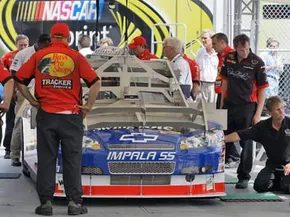
Long before the engines roar and the tires smoke, the real work begins. NASCAR inspectors don’t just walk the pits with clipboards. They bring out the heavy artillery. Specifically, a massive, welded-together template known as “the claw.”
It’s a single unit made of 19 individual templates fused together. It drops over the entire car like a spider. One size fits all? Not exactly. But it fits the Car of Tomorrow (COT) exclusively. Before the COT took over, inspectors used a messy collection of different gauges. Now, everything must fit within the grasp of that one giant metal claw.
If a car doesn’t slip through, it gets sent back to the garage. Teams rip off the body panels. They hammer out dents. They reshape sheet metal until it passes the test. It’s not free, though. NASCAR reserves the right to slap a penalty on the team. Usually, that punishment lands the following week. Sometimes, they impound the car right there on the grid. The team has to grab their backup or second car. A risky move when you’re trying to win.
Why The Claw Matters
The claw isn’t just measuring width and length. It’s hunting for cheats. Inspectors look for manipulated sheet metal. They check ride height. These tweaks offer aerodynamic advantages. The template catches them. Mechanical inspections happen too. Fuel tanks. Engines. Suspension. NASCAR rules are strict on displacement. No guessing. No gray areas.
Then there’s the wing. If you watch Sprint Cup races, you see it. The rear wings are always black. No decals. No paint. NASCAR issues each team a specific wing before every weekend. The dimensions are locked down. But teams still try to game it. They install the brackets at their own discretion. That opens a window for error. Or advantage.
Restrictor plates add another layer. These metal plates go over the air intake. They choke off airflow. Teams only use them at Talladega and Daytona. Superspeedways demand it. NASCAR officials place the plates themselves. They watch as teams bolt the carburetor down. Tampering with a restrictor plate is a death sentence for a season. The penalties are severe. No one has been caught doing it yet. Maybe because the risk outweighs the gain.
The Inspection Process Doesn’t End
Once the initial inspection clears, teams get to practice and qualify. But inspectors aren’t clocking out. They have two more days of work ahead. Teams still have plenty of time to tinker. They’ll push the limits again. The claw will wait.
Race day brings a new wave of scrutiny. Inspectors work through the pit road. They watch every swap. Every adjustment. The job isn’t done when the green flag waves. It’s done when the last hauler drives away. The oversight never stops.
The Hidden Battle Over Ride Height and Fuel
Qualifying ends. The crowd roars. But the real work begins in the shadows of the garage. NASCAR doesn’t just take your word for it. They inspect.
Teams have engineers who are smart enough to develop shocks that adjust during a run. It’s a legal loophole in practice, illegal in inspection. Cars are found too low in front or too high in rear. Why? Because physics. A low front end bites into the track. More downforce on the nose. Better grip in the turns. Teams want this. But if inspectors catch it, you’re in trouble.
Rear height is a different beast. Too high, and the rear wing catches more air. It sticks up higher into the oncoming wind. More rear tire grip. Also useful. But again, only if you’re within spec.
Fuel tanks are the other big target. Inspectors check capacity. Always. An extra gallon of gasoline isn’t just weight. It’s strategy. Running out of fuel because you packed too much gas in qualifying costs you lap time. Fuel strategy plays a major role on race day. Miss it, and you finish one lap down. Simple.
Morning Inspections: The Mallet Test
Race morning. You think you’re done? No. Teams roll through inspection again. Final pre-race check. It’s not as detailed as the initial post-qualifying look. But officials are watching. Especially the rear wing.
Inspectors use gauges. They slide them between the template and the hood. Check tolerances. If the gauge doesn’t slide freely, the hood is too high. The car fails. Teams bring rubber mallets to the inspection area for a reason. They hammer the body panels down. Adjust. Pass.
Once cars clear that line, they go to the shock station. Front of the garage. NASCAR inspectors watch every move. Teams charge shocks with the required pressure. Install them. Ready to go.
Inspectors Are Referees, Not Spectators
You think an inspector’s job is done after the cars leave the line? Think again. It’s time to watch the race, right? Pretty good perk.
Wrong.
Inspectors don’t get to rest during the four to six hours of a typical race. They serve as referees. Each inspector is assigned a driver. Their job? Make sure teams adhere to NASCAR rules. Every. Single. Minute.
They watch pit stops closely. Crews change tires. Fuel up. Inspectors check lug nuts. Are they all on the wheel studs? Did anyone cross the line too early? Did the jack drop too late?
Officials make judgment calls every race. One wrong move, and you get a penalty. Time penalty. Worse. It depends on the severity of the infraction. One missed lug nut? You might lose ten seconds. That’s a race-winning margin.
Post-Race: The Final Audit
The checkered flag waves. The crowd cheers. The winners celebrate. But for NASCAR officials, the work isn’t over.
Post-race inspection begins. Top five cars are brought through. Checked for measurements one more time. This is where big-time infractions are often found.
Why now? Because teams push limits. They adjust what they can during the race. They hide violations in plain sight. Post-race is the only time inspectors can see the true state of the car. No more racing. No more heat. Just cold, hard measurements.
We’ll look at how these penalties affect point standings next. Because winning the race isn’t enough. You have to keep it.
The Reality of Post-Race Scrutiny in NASCAR
Inspectors don’t just glance at the car. They measure. Specifically, they look at the height of the rear wing and the front splitter. NASCAR gives teams some slack here. Race damage happens. Cars get hit. Wings bend. So officials check if the measurements fall within a specific tolerance range. If they don’t, it’s an infraction. No questions asked.
Then there is the dyno test.
It’s not random. It’s strategic. NASCAR pulls race engines for inspection at their Research and Development Center in Concord. They run them on a dynamometer. The goal is simple: check horsepower output. Teams usually don’t sweat it. Most times, the numbers are clean. But occasionally, red flags go up. And when they do, the fallout is immediate.
Intent vs. Accident in Rule Breakers
Infractions happen. Every so often. Sometimes it’s just racing damage. Other times? It’s an attempt to game the system. Intent is the hard part. NASCAR has to judge. They have to decide if a crew chief was lazy or if they were cheating.
The Car of Tomorrow (COT) changed how penalties are handed out. It wasn’t just about the metal. It was about the attitude. The league shifted. They got stricter.
Penalties hit hard. Michael Waltrip Racing fired their crew chief in 2007 after finding an illegal substance in the fuel system of the #55 Toyota. More recently, Red Bull Racing let go of team members after illegal sheet metal was found on Brian Vickers’ #83 Toyota. Jobs are lost. Careers are stalled.
The Cost of Cheating
Since the COT era, fines are steep. We’re talking up to $150,000. That’s money gone. Plus point losses. The driver suffers. The team pays. It’s a costly mistake.
But here’s the kicker.
Wins rarely get stripped.
NASCAR doesn’t typically take the trophy away for post-race infractions. Usually, it’s just points and fines. There was one exception though. The 2008 Amp Energy 500 at Talladega Superspeedway. Regan Smith passed Tony Stewart under yellow. Stewart won the race. Smith got 18th place. That wasn’t a post-race inspection issue. That was a race-time violation.
When Wins Actually Change Hands
The closest NASCAR came to stripping a victory for a post-race technical failure was March 2008. Las Vegas. The UAW-Dodge 400.
Carl Edwards won. But his car had a loose cover over the oil reservoir. NASCAR claimed it could have allowed air to ventilate and boost downforce. They didn’t take the win. Instead, they docked him 100 points. And then the real blow: they took the 10 bonus points he needed for the Chase for the Cup.
It was a devastating blow to his championship hopes. Not because he lost the race. But because he lost the margin.
One last time. The modern era. 1991. Sears Point Raceway. Ricky Rudd bumped Davey Allison out of the way on the final turn. Rudd crossed the line first. NASCAR awarded the win to Allison. It wasn’t a tech inspection. It was a judgment call. Sportsmanship.
The system isn’t perfect. It’s never been about perfection. It’s about control. And sometimes, it’s about who you let win when the cameras aren’t looking.