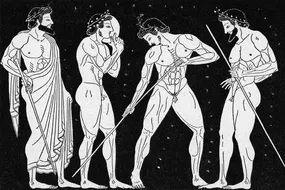
It’s not about shock value. For the ancient Greeks, nudity was a reality. They wear pleated clothes that can be thrown away in seconds depending on the situation. It’s not just about convenience. It’s all about functionality.
Athlete training as a delight. This approach has clear advantages. But this is more than a sport. The students listened to the lecture step by step. This lack of clothing is so common that it is part of the Olympics.
This tradition has deep roots. The earliest Olympic Games date back to 1100 BC. In the 7th century BC, Spartans were known to participate in the games without clothing. This is a bold move.
The results are undeniable. The winning percentage of naked athletes is high. The other competitors noticed too. They began to imitate this style. This is more than just a fashion choice. This is a winning strategy.
“When there were no dress restrictions, naked athletes won competitions at such a high rate that other competitors began copying their birthday suit styles.”
Nudity has been part of the Olympic tradition ever since. It lasted for centuries. Finally, the Christian emperor Theodosius banned these games in 393 AD. What is the reason? I support polytheism.
This transition marks the end of an era. The tradition of nudity in sports is closely related to the religious and cultural structures of ancient Greece. When this structure changed, this custom disappeared.
Today we look at the Olympics from a different perspective. You can see medals and records. However, its origins date back to a time when people celebrated their bodies in their most natural state. This is in stark contrast to modern sporting standards.
Why are they doing this? There are several reasons. Practicality comes into play. So is the competition. And maybe a bit of cultural pride.
The ban of 393 AD did more than end the race. It prevents us from living. Nudity is more than skin deep. It is a symbol of a society that values body and mind equally.
We can only guess what would have happened if the game had continued. Is the style evolving? Is it accepted in other cultures? The answer is lost to history.
But the evidence remains. The ancient Greeks thought nudity was fun. They found this effective. They take this belief to the world’s biggest stage.
The effect of this choice is subtle. This is how we think about the human body. How we feel about the competition. A way to remember the origins of the Olympics.
This reminds us that traditions are not permanent. It changes. I adapt. Sometimes it disappears.
But the memory of naked athletes remains. This shows that nudity was more than acceptable at that time. This is necessary.

The hidden benefits of #trainingnaked and why we still wear clothes
When the Olympics resumed in 1896, nudity disappeared from the Olympic stage. This is certainly not standard practice in professional baseball or major sports today. But what happens when you remove the synthetic materials? Are you missing out on physiological benefits by covering your body during exercise?
Modern sportswear is highly specialized. Golf clothing has evolved from basic polyester to light, effective blends. CrossFit participants wear shoes designed for their sport. Runners often wear moisture-wicking shorts with built-in support features. Antibacterial shirts are now a mandatory item in many gyms.
“Technology is really pushing the industry to come up with products that are really optimized for use, whether it’s working out, running or cycling,” Björn Bengtsson, a professor of fashion marketing at Parsons School of Design, told Men’s Health in 2017. He notes that the culture is moving from simple workout clothes to a wider lifestyle industry.
The proliferation of sportswear raises a rhetorical question. What happens when you remove your layers? Is it better to exercise naked?
For bare skin
Do clothes trap heat? Does it restrict movement? Or do they just obscure the true results of our work?
Robert Herbst defended the latter. Herbst lives in New York and is a personal trainer, coach and professional powerlifter. His resume is impressive. He is an 18-time world champion, 33-time national champion and a member of the AAU Strength Sports Hall of Fame.
He believes that training naked has clear advantages over that clothing masks. For Herbst, the most important advantage is visibility. You can’t criticize what you can’t see. If your goal is to build muscle or shape your body, fabric acts as a barrier. It hides the subtle twitch of the muscle fibers and the slight collapse of the shoulder blades during the lifts.
“You have to be able to know what you’re doing in order to improve.”
This is not just an aesthetic problem. It’s all about feedback loops. When you take off your uniform, you are forced to engage with your body in real-time. There is no padding between the skin and the mirror. Feedback is immediate and unfiltered.
Temperature control and comfort
In addition to visual feedback, heat is also a problem. Synthetic fibers are designed to wick away sweat but retain body heat at the same time. This can lead to overheating during high intensity strength training or high intensity interval training (HIIT). Bare skin allows for more efficient evaporation. It allows your body to cool down faster without the need for layers of polyester or elastane to trap warm air against the skin.
For those who wonder why exercising naked is good for cooling down, the answer lies in thermodynamics. Evaporation is most effective when air can flow directly over the skin. Clothing, no matter how “breathable”, they still create a microclimate. In hot environments or high power sessions this can be a limiting factor.
Psychological freedom
There are also psychological factors. Many people report that they feel liberated when they exercise without the constraints of clothing. No more pressure to wear tight gear. You don’t perform to an audience. you are performing for yourself. This will give you a more natural movement pattern.
However, this is not without social barriers. Most public gyms have dress codes
The risks of going commando
It may sound counterintuitive, but sometimes less is more. Or sometimes less is simply a bad idea.
The discussion about fitness clothes is not just about vanity. It includes physics, biology and basic hygiene.
Wearing the wrong clothes can ruin your workout. Is it too tight? Blood circulation is blocked and range of motion is limited. Isn’t it too loose? The fabric catches on equipment. Consider deadlifts. Loose pants rub against the bar. Friction slows down the rod. You try harder to lift less weight. This is a simple mechanical failure.
There are also skin factors. Chafing is bad. It’s even worse when sweat collects in your folds. A moist, warm environment is a breeding ground for fungi and bacteria.
Case for naked training
Some people believe that stripping down can completely solve these problems.
Exercising naked enables an optimal range of motion. No need to struggle with stretchy waistbands or stiff denim.
Kat Setzer, a Boston-based personal trainer, pointed out one particular benefit several years ago. Ditching the slimming panels and compression gear forces your muscles to work. They learn to stabilize the spine and pelvis by themselves.
This is the same as exercising with bare feet. Shoes cushion your feet. It also disconnect your sensory feedback from the floor. Your feet will be more stable if you don’t wear shoes. You get a clearer sense of alignment without restricting your clothes. Better alignment means more gains.
Why do you need pants
But here’s the problem.
San Diego doctor Alex Roher calls the idea of naked training an urban legend. he’s right to be skeptical.
Without a barrier, moisture sits on your skin. Nothing pulls it away. stagnant sweat can lead to yeast infections and bacterial growth. There’s a reason our fabrics are light, breathable and sweat wicking. They control the environment around your body.
Herbst agrees. He acknowledges the benefits of simple clothing, insists on balance. Clothes should serve a purpose.
It regulates body temperature. Keeps the muscles warm even in the cold. It wicks perspiration. Compression gears can actually improve performance by providing support.
There are also hygiene factors that no one wants to discuss.
Most gyms require closed toe shoes. Why? Prevents injuries caused by dropped weights. But clothing provides the same protection for everyone. It creates barriers.
Reports of the spread of MRSA and other infections in public gyms are true. It is always safer to reduce direct contact with other people’s sweat.
Psychological edge
There is another layer to this equation.
Researchers have discovered a phenomenon called the “enclothed cognition.”
Simply put, wearing activewear gives you a psychological boost. It makes you feel more active. It sends a signal to the brain that it is time to work.
So you don’t have to choose between performance and protection. You don’t need to wear stiff compression gear, but you should also avoid walking around naked.
Find a balance that works for your body. What if you want to maximize barefoot, alignment-focused feeling? Do it at home.
Just be careful with the javelin.