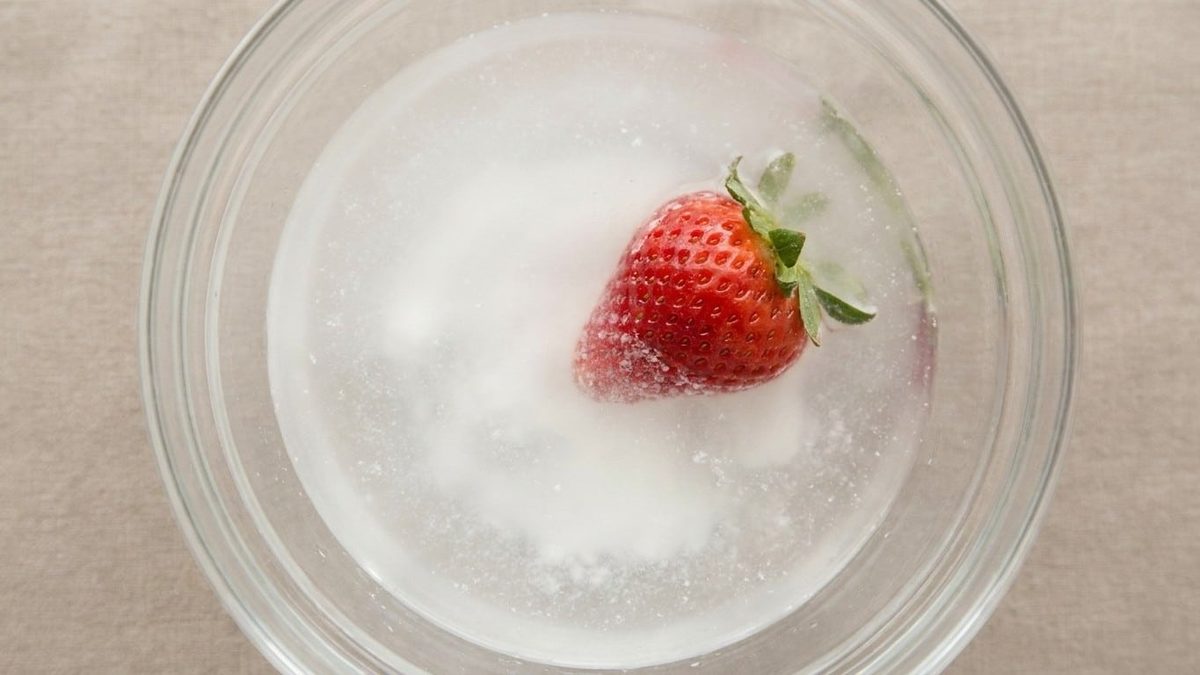
You likely have a bottle of white vinegar sitting in your fridge or pantry. It is the default tool for many French households when it comes to washing fruit. We have been conditioned to believe that soaking strawberries in an acidic bath is enough to strip away chemical residues.
Then comes the baking soda method. The water turns cloudy and green. Suddenly, the truth hits you. You were not cleaning the fruit. You were merely rinsing it.
The chemical limits of vinegar
White vinegar has legitimate antimicrobial properties. Its acidity disrupts microbial cell walls and helps lift surface particles. It works well against surface bacteria.
But when it comes to pesticides, the picture is less optimistic.
Running fruit under tap water does not remove all pesticide residues. Some pesticides are hydrophobic. They persist on the surface of the strawberry, making simple aqueous rinsing only partially effective. Vinegar offers limited advantage against these lipophilic molecules that cling to the thin skin of the fruit.
Soaking tender fruits in vinegar for more than two or three minutes can also alter their taste and texture.
There is a more serious issue. In March 2026, the Environmental Working Group (EWG) released its annual pesticide report. The conclusions shift the ground beneath our feet.
For the first time, the report revealed that over 60% of samples from the “Dirty Dozen” contain pesticides that are also PFAS. These are known as “forever pollutants.” The three most frequently detected pesticides on fruits and vegetables belong to this family.
PFAS are called forever chemicals because their molecular bonds take years, decades, or even centuries to decompose completely. No study demonstrates that vinegar eliminates them.
Why strawberries are high-risk targets
The 2026 “Dirty Dozen” list places spinach at the top. Strawberries, grapes, and nectarines follow closely among the most contaminated fruits. Strawberries have been on this list for years.
The reason is structural. The strawberry lacks a thick skin or protective rind. This exposes the flesh directly to the environment.
Many pesticides used on these crops are systemic. They are absorbed into the plant’s tissues. Surface washing reduces but does not eliminate exposure.
One sample in the report contained up to ten different pesticides on a single fruit.
According to USDA tests analyzed by the EWG, 75% of non-organic fruit and vegetable samples contained pesticide residues. This was after meticulous washing that replicated consumer habits at home.
PFAS contamination adds another layer of concern. The US Environmental Protection Agency (EPA) documents links between PFAS chemicals and multiple pathologies:
- Cancer
- Obesity
- Thyroid diseases
- High cholesterol
- Reduced fertility
- Liver damage
- Hormonal disruptions
- Immune system damage
These molecules do not behave like standard residues. You cannot simply detach them with a bit of acid. The EPA notes that some of these compounds can cause damage at minuscule levels, on the order of a billionth of a gram.
The baking soda bath: what the water reveals
This is where baking soda enters the scene. The visual difference with vinegar is striking.
Water becoming visibly cloudy after just a few minutes of soaking in baking soda translates a concrete chemical reaction. The baking soda bath relies on a basic chemical reaction that loosens undesirable molecules.
The alkaline pH of baking soda destabilizes pesticides adhering to the fruit’s surface. Here, the acetic acid in vinegar remains neutral or even counterproductive against these molecules.
Scientific data validates what the eye observes.
A key study showed that soaking for 12 to 15 minutes reduces up to 96% of phosmet residues (an insecticide) and 80% of thiabendazole residues (a fungicide).
These results were obtained by researchers at the University of Massachusetts and published in the Journal of Agricultural and Food Chemistry. They have been reproduced on several types of fruit.
Some studies specify that the water used should be warm, between 20 and 30 °C. This temperature range makes the chemical action more effective.
The protocol is straightforward. The solution must contain 10 grams of baking soda per liter of water. The soak must last at least 15 minutes.
But even with this method, systemic pesticides inside the fruit remain untouched. The surface is clean. The interior is not. We continue to eat what we cannot see.
Washing won’t fix everything
Let’s be clear: rinsing isn’t a magic wand. Researchers point out that you can’t wash away pesticides that have already migrated inside the fruit’s tissue. Once systemic PFAS are absorbed into the plant’s cells, no amount of external rinsing removes them. Baking soda beats vinegar for surface residues. It’s proven more effective. But it still doesn’t solve deep contamination.
Seasonality is the first real filter. You rarely hear it in debates about washing techniques, yet it matters. Strawberries harvested in May and June are generally cleaner. They grow in open fields. Strawberries found in January often come from greenhouses or are imported. The difference is significant. Organic strawberries contain three to five times fewer pesticide residues than conventional ones. That’s a measurable gap.
France is taking PFAS seriously. Legislation is shifting. Since January 1, 2026, France became the first European country to ban these “forever chemicals” in common consumer products. This includes clothing, shoes, cosmetics, and ski waxes. Agricultural pesticides containing PFAS are still circulating. Fludioxonil is the most frequently detected PFAS fungicide in the 2026 EWG report. It was found on 14% of all fruit and vegetable samples tested. It’s the most detected pesticide across all categories.
Changing how you wash is useful. But regulatory pressure on upstream substances is the most structural lever.
“The difference is significant. Organic strawberries contain three to five times fewer pesticide residues than conventional ones.”
Sources : foodandsens.com | ufcnouvellecaledonie.nc