


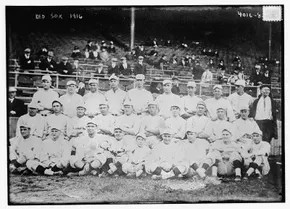
The Boston Red Sox entered 1916 with a fractured identity. The departure of key players after 1915 threatened to shatter team cohesiveness, but winning has a way of solving all problems. On Opening Day, Babe Ruth took the mound and delivered a 2-1 victory, kicking off a run of six wins in the first eight games. It was a strong start for a club that would need every bit of talent it had.
Ruth vs. Johnson: A Dominant Start
Ruth’s second appearance tested him against Walter Johnson, the Washington Senators right-hander widely considered the fastest and best pitcher in the game. Ruth won 5-1, marking his second straight triumph over Johnson in as many meetings. The rivalry was just beginning.
Throughout the spring, Ruth racked up six consecutive victories against “The Big Train,” five of which were decided by a single run. He established himself instantly as one of baseball’s dominant hurlers. Winning his first four starts, he helped propel the Red Sox to first place. Then, the offense collapsed.
Navigating the Offensive Slump
The loss of Tris Speaker left a gaping hole in the lineup, and the Red Sox slid into a horrendous batting slump. Even in this dry spell, Ruth usually pitched and hit well enough to keep the team afloat. On June 1, he out-dueled Johnson again in a 1-0 victory. Four days later, he tossed another shutout against Cleveland.
He lost his next start to Detroit but was perfect at the plate, hitting his first home run since the previous July. Three days later at St. Louis, manager Bill Carrigan called on Ruth to pinch-hit, and the Babe delivered a three-run homer. The next afternoon, he pitched the game, beating the Browns 5-3 while adding a third home run in as many games.
With his average now over .300, the idea of moving him to a daily defensive spot surfaced, but Carrigan never really considered it. Despite the weak offense, the conservative manager believed pitching and defense were the keys to repeating as champions. Ruth appeared to be not only the best pitcher on the staff but the finest in the league. To drive the point home, Carrigan kept Babe in the ninth spot in the batting order, the traditional position for pitchers.
The Home Stretch: Ruth Saves the Season
The Red Sox entered July in third place before catching fire. Ruth won four straight, including another 1-0 win over Walter Johnson that stretched to 13 innings, giving Boston a 6.5-game lead. Another slump followed, and the Red Sox dropped back to third place entering their final western road swing. This was when the Babe was called upon to save the season.
Facing the second-place White Sox before a crowd of over 40,000, the largest in Chicago baseball history at the time, Ruth earned his 20th victory with a 6-2 win to move Boston back into second. Drawing record crowds was becoming a regular event for Babe. An Ernie Shore victory the next day, coupled with a loss by the first-place Tigers, put Boston into the lead. A three-game sweep of Detroit the following week essentially wrapped up the pennant.
1916 Stats: A Historic Performance
His success against Johnson and in the season’s biggest games earned Ruth status as the ace of Boston’s pitching staff. At age 21, he was arguably the best left-hander in baseball.
- Record: 23-13
- Innings Pitched: 3232/3
- Strikeouts: 170
- Shutouts: 9 (an all-time record for left-handers that still stands)
- ERA: 1.75 (league-best)
- Opponent Batting Average: .201 (lowest in the league)
- Batting Average: .272 (including 19 pinch-hitting appearances)
Only Chicago’s Eddie Cicotte beat Ruth’s .657 winning percentage. Ruth’s 1.75 ERA has not been topped by a Red Sox pitcher since.
The World Series: The Longest Game in History
Boston faced the Brooklyn Robins in the World Series, and this time Ruth played a major role. Ernie Shore won the opener 6-5 at Braves Field. Babe started Game 2 before a delighted crowd of 41,373 and threatening skies. Dark clouds drifted in over the park as the game began.
Conditions looked ominous when the third batter for Brooklyn smashed a line drive to center that bounced to the wall for an inside-the-park homer, with outfielders Tilly Walker and Harry Hooper stumbling in pursuit. Trailing 1-0, Ruth escaped further trouble in the third when Robins pitcher Sherry Smith was tagged out trying to stretch a double into a triple. Babe got a reprieve with an RBI ground out later in the same inning, and it remained 1-1 for 11 more frames. Both teams had scoring chances thwarted by base-running blunders.
As the sky grew darker, Ruth seemed to get stronger. After allowing six hits and three walks through seven innings, he had relinquished just one walk and no hits over the next seven. When Boston came to bat in the bottom of the 14th, the umpires declared this would be the last half-inning.
First baseman Dick Hoblitzel led off with a walk (his fourth of the game against Sherry) and was sacrificed to second by Duffy Lewis. Pinch-hitter Del Gainor followed with a line drive over the head of the third baseman, who probably had trouble seeing it in the dark, and the winning run scored in what was then the longest World Series game ever played.
Joe Lannin probably had mixed emotions about the whole thing. Had the game remained tied through 14 innings, the umpires had ruled the contest would have been started from scratch the following day. That move would have most likely netted the host Red Sox some $100,000 in additional revenue.
Ruth Celebrates Series Victory With Carrigan
Ruth didn’t just celebrate. He exploded. After securing the first Series win, he jumped around the clubhouse, fueled by a year of pent-up frustration. He shouted directly at manager Jimmie Carrigan, reminding the old man of a conversation they’d had twelve months prior.
“I told you a year ago I could take care of those National League bums, and you never gave me the chance,” Ruth yelled.
Carrigan’s response was surprisingly gentle. “Forget about it, Babe,” he said. The warmth likely masked a deeper reality. Carrigan knew he wouldn’t have to tolerate Ruth’s wild antics much longer. The manager had already announced his retirement, set to take effect once the season concluded.
End of an Era at Braves Field
The Red Sox didn’t rest on that first win. They dispatched the Philadelphia Phillies in five games, claiming their second consecutive world championship. With the dust settling, the crowd at Braves Field swelled to a record 42,620.
It was a farewell tour for Carrigan. The veteran catcher waved goodbye to the fans before packing up and heading to Maine. The 1916 season ended on a high note for the franchise, but the landscape was about to shift dramatically. Ruth and the Red Sox were standing on the edge of massive changes in their future.


