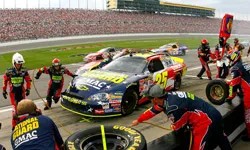
A driver might get the glory, but without the crew, the car falls apart before the checkered flag waves. They are the unsung heroes of NASCAR. They keep the machine breathing and rolling, yet they rarely get the credit they deserve. To the casual fan, they are just shadows in the garage. To those who know the game, they are the glue holding every victory together.
They are athletes, period. Fast, precise, and brutally efficient.
But you cannot ask a crew member to perform miracles with bare hands. A slugger needs a bat. Tiger Woods needs clubs. A pit crew needs tools. Without the right equipment, they are useless.
Here is a look at the 10 essential tools of NASCAR pit crew members, how they work, and the surprising tricks used to keep cars on the track.
10. The Pit Box
It sounds simple. It is not. The pit box is the command center. It is where strategy is born and lost.
It’s easy to think of a pit box as just a tent. It’s not. It’s the nerve center. Think of the bridge of the Enterprise. Every screen, every wire, every hum of electricity feeds into one goal: keeping the car fast.
A standard pit box is a fortress of data. Two satellite dishes track the sky. They watch the weather. They watch track temps. If a storm is brewing or the asphalt is cooling, the crew knows before the driver feels a slide.
Then there are the monitors. Flat screens. High definition. They give the crew a zoomed-in view of the car while it’s lapping around the track. This isn’t for show. It’s for diagnosis.
The crew sees what the driver can’t. A wobble. A misalignment. A tire pressure drop. They act as extra eyes. They spot trouble before it turns into a blown engine or a crash. Computers inside the box chew through performance data in real-time. Temperature. Pressure. Speed. All of it.
But it’s not all silicon and code.
Look closer. You’ll find the old school. Hand tools. Wrenches. Torque guns. And a wheel-and-axle assembly. Why keep a spare wheel in the box? Practice.
When the car is in the garage, the crew runs drills. They time their tire changes. They sharpen their movements. Muscle memory matters. A tenth of a second saved in the pits can mean the difference between a win and a lap down.
Power is another story. Race tracks are huge. They can fail. So every pit box has a generator. It’s backup. It’s insurance. If the grid goes dark, the box stays alive. Data doesn’t vanish. Monitoring doesn’t stop. The race continues.
The box keeps the car on track. But the real magic happens when the car pulls into the pit lane. That’s when the tools come out.
The Air Gun (Impact Wrench)
When the car stops, time explodes. The air gun is the hero of that chaos. It’s not a drill. It’s an impact wrench. Loud. Brutal. Fast.
It spins lug nuts off. On. In seconds. The sound alone triggers adrenaline in every fan watching. But speed is nothing without precision. Too tight, and the wheel seizes. Too loose, and it flies off.
The crew relies on these guns for every pit stop. They are the primary tool for changing tires. Without them, you’re waiting minutes. With them, you’re looking at two.
Changing a tire on a public highway is a slog. You wrestle with a rusty lug nut, your back aches, and time ticks away. NASCAR does it differently. The crew doesn’t use standard hand tools. They rely on high-powered impact wrenches to strip lug nuts in a blur of motion. This isn’t just about speed; it’s about mechanical necessity. A regular socket wrench simply cannot compete with the torque required to loosen a tire that has been torqued to perfection at 200 mph.
The result is a pit stop that defies physics. The best teams swap all four tires in less than 20 seconds. Twenty seconds. Try timing yourself changing a single wheel on your sedan. You’ll likely fail before the first nut even breaks loose.
The Maintenance Cost of Speed
There is a trade-off for this blistering pace. A hand ratchet never needs a rebuild. It’s steel and plastic. It lasts. But NASCAR air guns are pushed to their absolute limits. The stress is immense. The tools are subjected to constant abuse.
Most crew chiefs don’t wait for failure. They rebuild their impact wrenches after every 60 uses. That’s it. 60 pit stops. Then the tool comes apart, gets cleaned, inspected, and put back together. Why? Because a loose impact wrench means a stuck lug nut. A stuck lug nut means a penalty. A penalty means losing the race.
Where Does the Power Come From?
An air gun is only as good as its source. You can’t generate that kind of rotational force in a handheld unit without an external reservoir. The tool itself is just a trigger and a hammer mechanism. The real muscle is behind it.
So how do they keep the compressor running? And what happens when the air pressure drops mid-race?
If you think of a standard shop compressor, you imagine tanks of compressed oxygen and nitrogen mixed from the atmosphere. That is not what is under the hoods of NASCAR pit boxes. The term “air compressor” is a technical misnomer. These machines are filled with pure nitrogen.
The mechanics of the device remain familiar. It pressurizes the gas. When released, that pressure converts into kinetic force. That force spins the impact wrench or air gun. But the fuel source changes the game entirely.
Consistency Over Convenience
Why swap breathable air for nitrogen? The answer lies in stability. Standard air contains moisture. Moisture expands and contracts with temperature swings. On a track where surface temps can swing from 80 degrees to 120 degrees in an hour, that variability introduces risk.
Nitrogen is inert. It is consistent. It does not react dramatically to humidity spikes or sudden heat waves.
With nitrogen in their compressors, crews can be assured equipment won’t malfunction due to extreme race day conditions.
This consistency ensures the torque output of the impact tool remains predictable. A loose lug nut requires a specific amount of force. Too much, and you strip threads. Too little, and the wheel flies off. Nitrogen delivers that force reliably, lap after lap.
The Lift
Before the nitrogen-powered guns can do their work, the car needs to clear the ground. You cannot remove tires from a car sitting on asphalt. The process starts with the jack.
Speed is the metric. The clock is already ticking. The crew chief barks the signal. The jack man dives in. The car rises. Fast. This mechanical lift is the prerequisite for the pneumatic violence that follows. Without height, the tools are useless. With it, the three-second window opens.
The Mechanics of the Lift
You wouldn’t think much of a car jack until you’re stuck on the shoulder of a highway with a bald tire. Most vehicles come with a basic, factory-issue lever type in the trunk. It works, eventually. You pump it. You crank it. You wait. But in NASCAR, waiting is the only thing slower than a flat tire.
Race cars don’t just change tires; they swap them out in seconds. And they do it multiple times per event. The stress on the rubber is immense, and the clock is ticking. This is where the standard automotive jack fails completely. Enter the specialized NASCAR pit jack.
It’s not about brute force. It’s about hydraulic efficiency. A single pump of the handle is all it takes to lift thousands of pounds of steel and carbon fiber into the air. Compare that to the rusty scissor jack in your glove box, which requires a workout just to get the rear axle off the ground. The NASCAR tool uses powerful hydraulics to bypass the labor entirely. Speed is the currency here.
Weight matters, too. These jacks are typically constructed from aluminum. Lightweight. Durable. Easy for a crew member to slide under a car that is sitting just inches off the asphalt.
The Jack Man’s Role
Every pit stop has a hierarchy. One person owns the lift. He is the jack man.
His job is precise. He doesn’t lift the whole car at once. He lifts one side at a time. While he works, two tire-changing teams swarm the vehicle. One team rips the lug nuts off the left side. The other handles the right. They swap the rubber. They tighten the bolts. And they do it while the jack man holds the car steady in the air, waiting for the signal to drop it back down.
It’s a dance of milliseconds. If the jack man hesitates, the stop drags. If he drops the car too early, the tire team loses their leverage. He is the anchor of the operation.
But there is a variable he can’t control. Alignment.
What if the jack man approaches the car and the lift point isn’t where it’s supposed to be? What if the car is sitting crooked in the pit box? Or worse, what if the car is already in motion when he tries to slide the jack in?
Read the next page to find out how the team gets the car in the air.
6: Piano Bars
How Pit Crews Lift Damaged NASCAR Cars With Piano Bars
If you’ve ever watched a pit stop go sideways, you know the panic. A car rolls in with the undercarriage scraped raw, tires shredded to ribbons, sitting so low the asphalt is practically kissing the chassis. The jack man is waiting, jack in hand, but there’s zero clearance. You can’t lift what you can’t reach. This is where the humble piano bar saves the race.
It’s not high-tech. There are no hydraulics, no electronics, no moving parts to jam. Just a long, rigid steel bar. The crew slides it under the car’s frame, positions it like a lever, and pushes down. Simple physics. The bar gives them the mechanical advantage needed to pry the heavy vehicle up just enough inches to slide the hydraulic jack underneath. It’s the failsafe when the standard equipment fails. Add some muscle, apply pressure, and the car rises.
5: Fuel Cans
Speaking of getting the car moving, fuel is the lifeblood of NASCAR. You can’t win if you aren’t running. But unlike your daily commute, there are no gas stations on the track. So how do these monsters drink their fill in seconds?
The answer lies in the fuel cans.
These aren’t your grandfather’s jerry cans. They are specialized, lightweight reservoirs designed for speed and safety. Each can holds roughly five gallons of fuel, and a full refueling stop typically requires three to four cans to fill a tank that can hold up to 20 gallons depending on the track length and race strategy.
The process is a blur of motion. A crew member grabs a can, the nozzle is inserted, and the fuel flows. It’s fast. It’s messy. It’s critical. One wrong move, one spill, one missed can, and you’re losing track position. The fuel cans must be handled with precision, passed efficiently from the spotter to the pit crew, and emptied without delay.
Why does this matter? Because every second spent refueling is a second lost to the leaders. And in NASCAR, gaps are measured in hundredths of a second. The fuel cans are not just containers; they are the instrument of endurance. Without them, the race ends before it begins.
But there’s more to the story than just pouring gas. There’s the strategy. The weight of the fuel. The timing. The way the car handles with a full tank versus an empty one. It’s a balancing act, both literally and figuratively.
You can’t run 500 miles on an empty tank. That’s the baseline. But the real tension in NASCAR isn’t just about making it to the checkered flag; it’s about the math of weight versus speed. How much fuel does a car actually carry? When do they fill up? These aren’t just logistical questions. They are the core of racing strategy.
The dilemma is brutal. Fill the tank to the brim, and you save a pit stop. You stay on the track longer. But that extra fuel adds hundreds of pounds of dead weight. The car slows down. Turn in times get sluggish. Handling suffers.
Skip the extra gas, and you go lighter. Faster. But now you’re flirting with disaster. Run out of fuel on the track, and you’re pushing a 3,500-pound piece of metal back to the garage. You lose time. You lose positions. You lose the race.
Every crew chief, spotter, and engineer lives in this uncertainty. Fuel strategy is a high-wire act performed at 180 mph. And the tools they use to execute it are surprisingly analog.
The Weight of Gasoline
Most people imagine fancy pumps or digital meters. They don’t get it. NASCAR teams use fuel cans. Basically, an upside-down jug with a long, rigid spout. The gas man grabs them. He runs them over the pit wall. Straight to the car.
He doesn’t carry one. He carries two.
Each can weighs up to 90 pounds. Full. That’s a lot of weight swinging around a garage at full speed. If he trips? If he slips? The race changes in a split second.
There’s always a backup. The catch can. Smaller. Held by the gas catch man. Its job is simple: catch the overflow. Catch the spill. Catch the mistake. Because when you’re pouring 10–15 gallons of gas into a car in under eight seconds, mistakes happen. Spills happen. The catch man is there to clean it up. Literally. To keep the track safe. To keep the pit box clear.
When Things Fall Apart
You read that last part literally. Things fall apart.
Cans crack. Spouts bend. Tires blow. Aerodynamic pieces detach. And when they do, you can’t stop the race. You can’t call for a new part from the manufacturer. You work with what you have.
Which brings us to the unsung hero of NASCAR engineering.
4: Duct Tape
Not the shiny silver stuff from Home Depot. The heavy-duty, industrial-grade, black or gray tape that smells like rubber and desperation.
It’s not just for holding a cracked bumper on. It’s structural. It’s aerodynamic. It’s insurance.
When a car loses a piece of bodywork mid-lap, the air flow changes. Drag increases. Downforce vanishes. The car handles like a shopping cart. The crew chief sees it. The spotter screams it. The driver feels it.
And the pit crew fixes it. With tape.
They don’t have time for welders. They don’t have time for composites. They have 13 seconds. They rip off a strip of duct tape. They slap
It makes sense, right? If you’re staring at a leaky pipe or a broken handle, duct tape is the lazy man’s lifeline. But here’s the twist: it’s also indispensable for NASCAR crews. These guys are mechanics. They’re engineers. They’re some of the most skilled hands in motorsports. So why are they slapping adhesive strips on million-dollar race cars?
Because it works. Fast.
Forget the idea that tape is just for holding things together until you can do it “properly.” In NASCAR, proper might take an hour. The green flag drops in ten minutes. Crew members use duct tape for immediate, functional adjustments. They shift body panels slightly to tweak downforce. A millimeter here or there changes how air flows over the hood. It’s not sloppy; it’s aerodynamic fine-tuning under pressure.
They tape up loose wires. They secure hoses that are threatening to pop off. They block air vents to manage engine temperature, redirecting airflow where it’s needed most to keep the combustion cycle efficient. It’s a quick fix that keeps the car on the track when a bolt or bracket might fail.
This isn’t just makeshift engineering. It’s strategic. You can buy NASCAR-branded rolls at the track store. Fans call it 200 mph tape. The name isn’t marketing fluff. It’s earned. The tape holds under forces that would rip ordinary adhesives apart.
But what happens when the heat gets too intense? When the engine is screaming at 9,000 RPM and the tape starts to soften? That’s when the crew reaches for something stronger. Something that doesn’t just stick, but fuses.
3: BearBond
When 200 mph tape fails, the solution is BearBond. This isn’t just another brand of adhesive. It’s a specialized, high-temperature bonding agent designed specifically for the extreme conditions of stock car racing. While duct tape handles the quick, temporary fixes, BearBond is used for repairs that need to survive the full race distance without degrading under radiant heat. It’s the difference between a patch that holds for a lap and one that holds for 200.
Duct tape is the Swiss Army knife of racing repairs. It fixes loose hoses, secures loose bolts, and apparently, even torn prom dresses. It’s versatile. It’s accessible. But when a Cup Series car takes a hit, adhesive strips just don’t cut it. That’s where BearBond enters the garage.
Don’t let the name fool you. This isn’t a toy. BearBond consists of massive sheets of industrial-grade adhesive that are sticky enough to make you regret every life choice leading up to that moment. If you get stuck to it, you aren’t getting off it easily. That extreme holding power is exactly why NASCAR crews rely on it for large body repairs.
Think about the physics. You’re trying to reattach a fender that’s been shredded by another driver’s tire. Duct tape requires layering dozens of strips. It’s tedious. It’s weak under high-speed aerodynamic pressure. BearBond is one continuous, heavy-duty sheet. You slap it on. It holds. It’s the difference between a quick fix and a part that stays put for 500 miles.
For small jobs, keep your duct tape handy. It’s still king under the hood for securing wires or taping up a cracked filter housing. But for structural body work, BearBond is the only option that makes sense.
The catch? You probably can’t grab a roll at your local hardware store. It’s specialized equipment. But while you’re hunting for that specific adhesive, let’s look at the tools you already have in your garage. The ones that don’t require a special order. The ones that involve impact and force.
Hammers, Baseball Bats and Saws
You might think a baseball bat has no place in a professional racing pit box. In most cases, you’re right. But in the chaotic minutes before a green flag, improvisation wins races. When a piece of bodywork is bent but not broken, a soft-faced hammer—or sometimes just a well-placed thump with a bat—can coax metal back into position. It’s crude. It’s unrefined. But it works when you don’t have a hydraulic press.
Saws are next. Not for cutting cars, exactly, but for trimming debris. Carbon fiber dust flies. Plastic shards scatter. If you need to clean a edge or cut a strap, a simple hand saw is faster than fiddling with a knife. It’s about speed. It’s about having the right tool in your hand before the engineer starts yelling.
These aren’t glamorous solutions. They’re ugly. They’re practical. And in NASCAR, practical wins.
A dented fender on your daily driver spells a trip to the body shop, specialized tools, and a bill that makes your wallet cry. NASCAR handles body damage differently. When a stock car takes a hit, the crew doesn’t reach for heat guns or suction cups. They grab hammers, baseball bats, and saws.
It feels wrong. You spend weeks engineering a precision machine watched over by satellites and thousands of dollars in telemetry equipment. Then, on race day, a crew chief starts whacking the side panel like he’s trying to extract a confession.
But it works. If the body is crushed, aerodynamics die. Drag increases. Downforce drops. The car becomes uncontrollable. The damage can also rip apart suspension components or tear loose body panels. Speed dies. So, when you see a pit crew beating on a car with blunt instruments, they aren’t losing their minds. They are saving a lap.
They are fixing the airflow. They are saving the car.
Extension Poles: The Unsung Hero
Up next, we look at one of the simplest tools NASCAR teams use on race day. It proves to be one of the most versatile pieces of equipment in the garage.
Extension Poles
You might not think of an extension pole as a critical racing tool. But in the high-stakes world of NASCAR, reach is everything. These poles are used for a variety of tasks that seem minor but have massive implications for race strategy.
One of the primary uses is adjusting the air dam or splitter. These components sit at the very front of the car, low to the ground. Adjusting them by hand is awkward. It’s difficult to get the right leverage. An extension pole gives the crew the reach they need to make precise adjustments without crawling under the car.
But the versatility doesn’t stop there. Crews use extension poles to:
- Remove debris: Nails, screws, or small pieces of tire rubber can get stuck in the grille or under the car. An extension pole lets them poke it out quickly.
- Check fluid levels: In some cases, you can use it to probe reservoirs or check for leaks in hard-to-reach areas.
- Assess damage: After a hard hit, a pole can be used to gently probe the bumper or spoiler to see if it’s loose or cracked without causing further damage.
The beauty of the extension pole is its simplicity. It doesn’t require power. It doesn’t need batteries. It doesn’t break down. It just works. And in a sport where seconds count, reliability is king.
Think about it. What if the crew could adjust the splitter in two seconds instead of ten? That’s a lap saved. That’s a position gained. That’s the difference between winning and going home.
The extension pole is a testament to the NASCAR philosophy: use the right tool for the job, even if that tool is just a long stick. It’s not flashy. It’s not high-tech. But it gets the job done. And in racing, getting the job done is the only thing that matters.
What other simple tools do you think are overrated in motorsports? Or are they all essential?
It is easy to dismiss the obvious. In a garage filled with torque wrenches, air guns, and specialized jacks, a long stick seems like an afterthought. Yet, the extension pole stands as one of the most critical instruments in the NASCAR pit crew’s arsenal. The irony is thick. Most of the time, the pole never actually makes contact with the vehicle. NASCAR regulations strictly limit how many team members can cross the pit wall during a stop. To bypass this constraint, crews use the pole to perform tasks from the safety of the team’s designated area.
Why the Pole Matters for Airflow and Safety
The tool serves multiple functions, all aimed at shaving fractions of a second off the lap time. Crew members use the extended reach to wipe down the windshield. Dirt, bug residue, and debris accumulate fast on track. A clear view is non-negotiable for the driver. Simultaneously, they scrub the grille. Clearing debris from the front fascia allows air to flow freely into the engine bay. Better airflow means better cooling. Over a 500-mile race, engine temperature can dictate whether a car finishes or fails.
Hydration is another critical factor. Drivers sweat heavily. The cockpit acts like an oven. Crew members use the pole to pass a water bottle to the driver. This small interaction keeps the pilot hydrated and focused. It is a simple gesture, but dehydration leads to slow reaction times. In a sport where mistakes cost positions, maintaining peak physical condition is part of the mechanical strategy.
Signaling the Driver Into the Pit Box
The most vital use of the extension pole happens before the car even rolls into the pit box. The pit area is chaotic. Drivers navigate through a gauntlet of crew members, tools, and other cars. It is loud. It is confusing. For a driver who has been racing at 200 mph for hours, navigating the pit lane requires intense concentration.
Crews attach signs to the end of the extension pole. These signs act as a beacon. They signal the driver to enter the correct pit stall. Getting the car into the right spot quickly prevents collisions. It prevents delays. Every second spent hesitating or moving slowly adds up. In the final laps of a tight championship battle, those seconds determine the winner.
The Strategic Value of Simple Tools
The extension pole exemplifies a broader truth in racing. Complexity often masks simplicity. Teams spend millions on aerodynamics and engine tuning. They optimize tire compounds and fuel strategies. Yet, a basic stick helps execute these plans. It bridges the gap between regulation and reality. It allows the team to work within the rules while maximizing efficiency.
Drivers rely on the crew to maintain the car. The crew relies on the pole to reach the driver. It is a chain of trust. A missed signal leads to a wrong box. A dirty windshield leads to a blind spot. A clogged grille leads to overheating. Each element contributes to the final result.
The pole is not just a tool. It is a lifeline. It connects the team to the car. It connects the strategy to the execution. Without it, the pit stop becomes a exercise in frustration. With it, the crew operates with precision.
More on Racing Strategy
For deeper insights into how teams optimize every aspect of their operation, explore additional resources on NASCAR maintenance and pit crew