


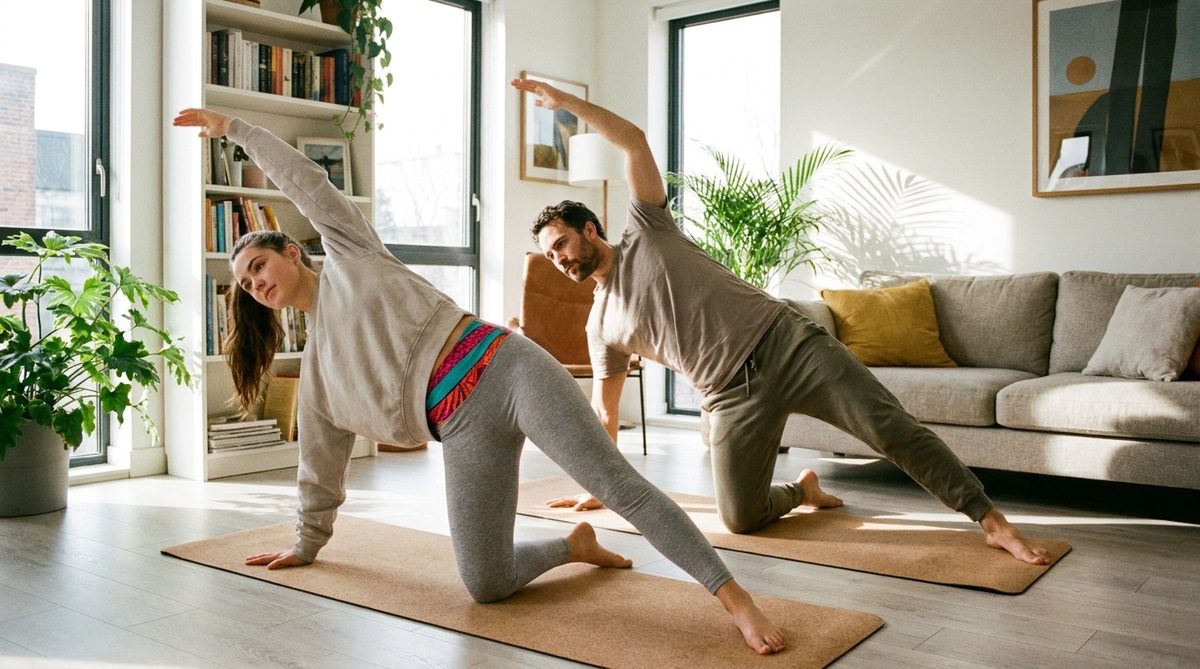
You spend eight hours a day slumped in a chair. Your back is starting to charge you for it, daily. You hit the gym or go for a run, only to end up stiff in your hamstrings or lower back. Instead of feeling loose, you feel locked up.
Stop doing those rushed, sloppy stretches. Spring is here. The real fix for unlocking stiff joints and taking pressure off your spine sits on a simple yoga mat.
Why Pilates Builds a Strong Core and Repairs Daily Damage
Pilates used to have a reputation. People thought it was just stretching for women. That view is outdated. It is now a rational choice for men, especially in spring.
Sitting behind a screen all day ruins your posture. Your spine rounds. Your shoulders drop forward. Your spinal discs compress. Slowly. Insidiously.
Pilates fixes this. It builds deep muscle. It targets specific areas. There is no impact trauma. It works the stabilizers in your back. It engages your entire abdominal wall. Think of it as a natural corset. It straightens your posture. It neutralizes the chronic tension caused by sitting.
How Core Strength Boosts Lifting and Running
Do not mistake slow movement for easy movement. It takes massive core stability to control a slow, fluid motion.
Many athletes add this to their spring training. They know why. Whether you are squatting heavy weights or trying to improve your running economy, power starts in the center.
A rigid trunk is non-negotiable. It ensures energy transfers precisely to your limbs. It lowers your risk of injury over time. Long term, it protects you.
Activating Stabilizer Muscles with Precision
You need to unroll that mat. You need to wake up every fiber of your stabilizer muscles. It starts with breathing.
Mastering Thoracic Transverse Breathing for Core Activation
Effective biomechanics rely on precise breathing. Forget basic belly breathing. That just pushes your abdomen out.
The secret lies in lateral thoracic breathing. Inhale deeply through your nose. Widen your ribs on the sides. Think of an accordion opening. Keep the tension in your abdominal wall intact.
Exhale through your mouth. Engage your pelvic floor. Tighten your waist. This creates high intra-abdominal pressure. It is protective. It secures your lumbar vertebrae during every effort.
Mastering Foundational Movements: The Hundred and Spine Stretch
Alignment is everything. Precision separates air-blowing from real strengthening.
Take the Hundred. It is not just another set of basic crunches. Keep your legs straight. Lift your shoulder blades off the mat. Perform small, firm, dynamic arm beats. Maintain total stability in your ribcage.
Then there is the Spine Stretch Forward. It is a lesson in motor control. It teaches you to articulate your back vertebra by vertebra. You fight gravity with intense concentration.
Nothing is left to chance. Every joint angle has a function.
Managing the initial resistance to movement
The first few times you unroll your mat, your body will push back. It has spent years adapting to stiffness and compensation patterns. This physiological protest is normal. The goal isn’t extreme flexibility on day one. It is retraining your body to move intelligently.
You need practical adjustments to navigate this resistance.
- Bend your knees slightly during leg extensions. If neural tension builds behind your thighs or in your lower back, a slight bend relieves the strain.
- Elevate your hips. Place a dense block under your glutes during seated poses. This aids spinal alignment significantly.
- Slow down. Halving your execution speed exposes hidden compensations. It also maximizes the recruitment of slow-twitch muscle fibers.
These small tweaks prevent injury. They make the process sustainable.
The long-term payoff of consistency
Two short sessions a week yield tangible results. You will notice changes in daily life. Standing at your computer, you will find yourself sitting straighter. It becomes spontaneous rather than forced.
Your hips will feel less stiff upon waking. Shoulders, often crunched by stress, will drop to their natural position. This is the functional intelligence of the training. You strengthen to relax what suffers from tension. You stabilize what suffers from chronic weakness.
Investing time on the mat is one of the most cost-effective strategies for the active individual. It is about more than a toned silhouette. It is about building a resilient body. One that can withstand injury. One that excels in other athletic pursuits.
The foundation for the spring is built now. Are you ready to leave old prejudices behind? Or will you hesitate until the season passes?


